
Blog

Paint Finish
Blog

Paint Finish Types Explained: Which One Do You Need?

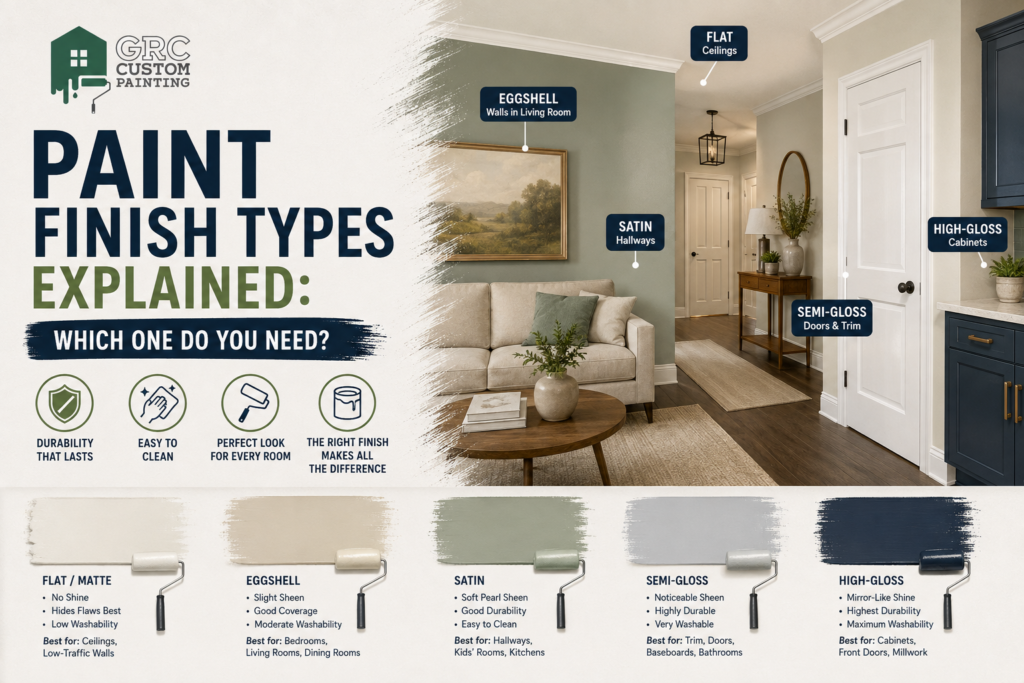
Most people walk into a paint store with the colour already decided. Then someone asks what sheen they want, and the whole thing stalls. It is a fair place to get stuck. Paint finish types affect how durable the wall is, how easily it cleans, how much of your drywall’s history shows, and whether you can ever touch up a scuff without repainting the room. Paint manufacturers do not make it simpler. One brand lists nine finishes. Most homes need three or four. I am Gerry, and I have been painting interiors and exteriors around Woodland, Davis and Sacramento for twenty-five years. At GRC Custom Painting I am the one who prices the job and the one who rolls it, so I have no reason to sell you a finish you do not need. Here is how I actually pick. What Is Paint Sheen, and Why Does It Matter? Sheen is how much light the dried paint reflects. It is not a coating over the colour, it comes from the ratio of binder to pigment in the can. More binder means more shine, a harder film, and better washability. It also means the surface underneath has nowhere to hide. That is the trade-off governing every decision in this article: shine buys you durability and costs you forgiveness. Everything below follows from that one sentence. Sheen changes how colour reads, too. The same soft grey looks lighter and cooler in satin than in flat, because more light is bouncing back at you. Sample on the actual wall before committing. What Are the Main Paint Finish Types? Five finishes cover nearly every residential job. Names differ by brand, and some of those extra options are marketing rather than new categories velvet, pearl and low-lustre all sit between the standard five rather than adding to them. Match on gloss level, not on the name printed on the label. Finish Shine Hides flaws Washability Best for Flat / Matte None Best Lowest Ceilings, low-traffic walls, textured drywall Eggshell Slight Good Moderate Bedrooms, living rooms, dining rooms Satin Soft pearl Fair Good Hallways, kids’ rooms, kitchens Semi-Gloss Noticeable Poor High Trim, doors, baseboards, bathrooms High-Gloss Mirror-like Worst Highest Cabinets, front doors, feature millwork Flat and Matte: What Is the Difference? Not much. The distinction is largely branding, though matte usually carries slightly more binder and takes a gentle wipe better than true flat. Both are non-reflective, and both hide wall imperfections better than anything else you can buy. The drawback is real. Flat scuffs easily and cannot be spot-cleaned, rubbing at a mark tends to burnish it and make things worse. When Should You Use Eggshell or Satin? These two cover most of the walls in a typical house. Eggshell has a slight sheen and suits calm, low-traffic rooms, bedrooms, formal living rooms, dining rooms. It cleans better than flat while still forgiving minor drywall flaws. Satin has a soft pearl-like sheen and belongs where hands, pets and cleaning happen. Hallways, kids’ rooms and kitchen walls are its natural home. The catch with satin is that it shows roller marks and surface flaws that eggshell hides. If the drywall is not in good shape, satin will tell everyone. Is Semi-Gloss or High-Gloss Better for Trim? Semi-gloss is the standard for trim, doors, baseboards and casing. It is durable, washable, and its shine separates the millwork from the wall visually. High-gloss goes on cabinets and front doors where you want a near-lacquer result. It is unforgiving of both the substrate and the person applying it, every brush mark and bit of raised grain shows. Rarely a sensible DIY finish. Which Paint Finish Is Best for Each Room? Room function decides sheen more than taste does. I look at moisture, then traffic, then the condition of the walls, in that order. Kitchens take satin on the walls. It handles grease and wiping without turning the room into a mirror. Bathrooms are where I disagree with the standard advice. Semi-gloss walls are a holdover from before satin formulations improved. In a bathroom with a working extractor fan, satin has plenty of moisture resistance and looks far better. Bedrooms and formal living rooms suit eggshell. They are low-traffic, and the softer finish makes the room feel calmer. Hallways and stairwells need satin. These are the highest-contact surfaces in any home and they get scrubbed the most. Ceilings take flat, always. A ceiling is a wide, poorly-lit plane where every seam and texture inconsistency waits to show, and any sheen will find them. Trim, doors and cabinets take semi-gloss or high-gloss, for the durability and the visual separation from the walls. If you are pulling a whole interior painting project together, this contrast is what makes it read as finished rather than flat. Which Paint Finish Hides Wall Imperfections Best? Flat wins outright, with eggshell a clear second. The reason is physics. Light travelling across a wall at an angle rakes over every seam, patch and nail pop, and a reflective surface throws that back at you. Absorb the light instead and the flaws largely disappear. This matters a great deal around here. A lot of the housing stock in Woodland and Davis is 1950s through 1970s ranch, and those walls have had decades of settling, patching and texture repair. Putting satin on them is asking for trouble. Why Does Touch-Up Paint Look Shiny? This is the question I get most often after a job, and almost nobody covers it before you choose a finish, which is when it matters. A touch-up can match the colour perfectly and still look wrong. Colour and sheen are two different things, and only one comes out of the can. Sheen depends on how the surface absorbed the paint, how it was applied, and whether the wall is carrying a full two coats. Dab fresh paint onto a spot and it often dries with a slightly different reflectance than everything around it. That is flashing, and it shows up worst at an angle
Limewash vs Whitewash
Blog

Limewash vs Whitewash Brick: Which Is Right for Your Home?

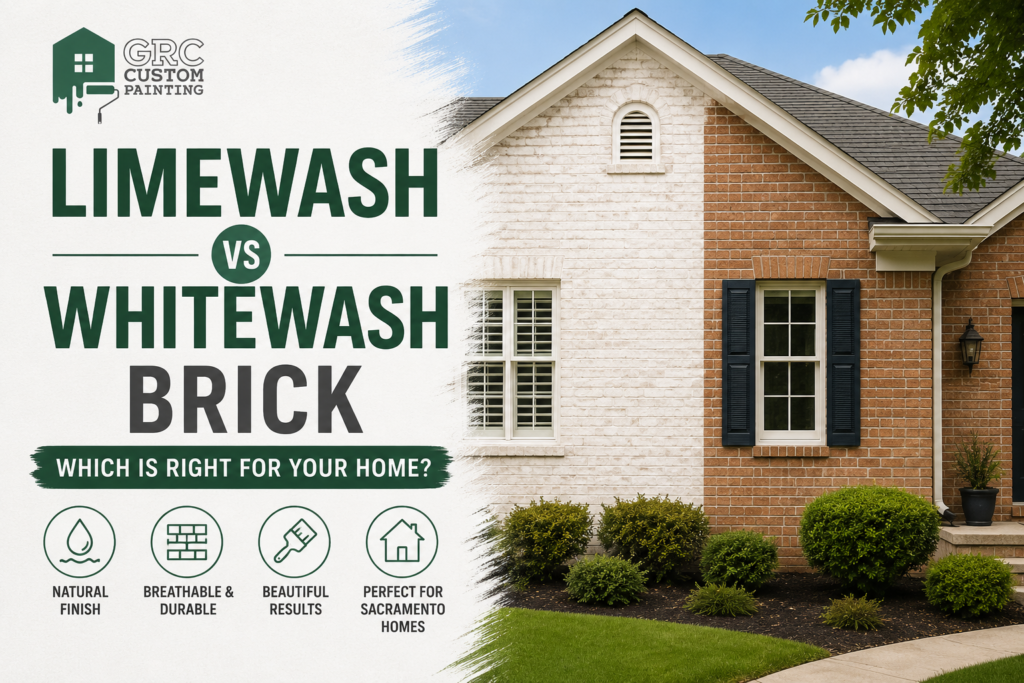
Dated brick is one of the most common things homeowners ask me about. The house is solid, the masonry is fine, but that peachy red or dark rust colour makes the exterior feel decades older than it is. Two options come up straight away, and they sound like the same thing. They are not. Limewash and whitewash produce different finishes, last different lengths of time, and commit you to very different levels of permanence. I am Gerry, and I have prepped and coated masonry for twenty-five years across Woodland, Davis and the greater Sacramento area.  At GRC Custom Painting I handle every project personally, which means I am the one looking at your brick and the one coating it. If you already know you want it refreshed, you can see my exterior painting services, but read this first, because choosing the wrong finish is expensive to undo. What Is Limewash, and How Does It Work on Brick? Limewash is one of the oldest masonry coatings there is, slaked lime, meaning limestone fired and then hydrated, mixed with water and sometimes a mineral pigment. What makes it different from paint is where it ends up. Limewash soaks into the porous surface of the brick rather than forming a film across it. Once on the wall, the calcium hydroxide reacts with carbon dioxide in the air and hardens back into a mineral layer, effectively becoming part of the brick face. That is why limewash stays breathable, the masonry can still release moisture, which matters on older brick. It also ages in a way paint never does. Limewashed brick develops a chalky, matte patina and erodes gently, so it softens rather than fails. Some people love that weathered European look; others find the lack of uniformity frustrating, and it is worth being honest about which camp you fall into. Colour range is the real limitation white and a narrow band of earth tones. It is low in VOCs, though, which matters with children or pets in the house. What Is Whitewash, and How Is It Different? Whitewash is diluted paint, roughly a half-and-half mix of water and latex or acrylic, brushed on thin so the brick’s texture and variation still read through. The critical difference is that whitewash sits on top of the brick, forming a thin, semi-transparent film rather than penetrating it. That film is where its advantages come from. The finish is smoother and far more uniform, the colour range is effectively unlimited, and it will go over brick that has already been painted. It also wears differently. Being a film, whitewash can chip or peel at the end of its life instead of eroding. On older, softer brick there is a real moisture-trapping concern, which is why I lean toward a breathable mineral paint over standard latex on original masonry. Limewash vs Whitewash Brick: What Are the Real Differences? Most articles define both finishes and stop there. Here is the side-by-side people actually want when they search the difference between limewash and whitewash. Limewash Whitewash Made from Slaked lime and water Diluted paint and water How it bonds Penetrates the brick Sits on the surface Finish Chalky, matte, textured Smoother, more uniform Breathability Vapor-permeable Forms a film Colour range White and earth tones Effectively unlimited Over painted brick? No Yes Reversible? Largely, by power washing Difficult Best suited to Unpainted brick, aged look Painted brick, fireplace surrounds The line that decides most projects is the one about painted brick. Limewash needs raw, porous masonry to bond with, so if yours has already been painted, the choice makes itself. How Long Does Limewash Actually Last on Brick? Published figures run from five years to thirty, which is not helpful when you are planning. The spread is real, and it comes down to four things. The first is preparation. Limewash on brick that was properly cleaned and left unsealed lasts far longer than limewash rushed onto a dirty wall. The second is coat count. Thin coats applied with a natural bristle brush, each cured before the next, build a finish that holds. One heavy coat does not. The third is exposure. South and west elevations take the worst of the sun, and that is where fading shows first. The fourth is maintenance. Limewash is meant to be touched up rather than replaced, and a recoat every few years extends it for decades. For exterior brick in this climate, plan on refreshing in the five to ten year range. Whitewash holds its look longer up front, then fails more visibly, a film chipping looks worse than lime chalking. What Does It Cost to Limewash or Whitewash Brick? Published national figures put professional limewashing and whitewashing in a broadly similar range per square foot, with most whole-house projects landing in the low thousands. That surprises people, because limewash materials are cheap. The cost sits in labour — thin coats and proper drying time between them cannot be rushed. What moves the number most is neither product. It is the condition of the brick and the prep it needs: cleaning, mortar repair, and how much of the wall is reachable without staging. Can You Remove Limewash or Whitewash Later? This is the question almost nobody addresses, and for an exterior decision it should carry real weight. Limewash can generally be removed by power washing, especially in the first stretch after application. It is not always perfect on deeply porous brick, but it is achievable without damaging the masonry. Whitewash is paint, so removal means chemical stripping or media blasting. Both are expensive and both risk damaging the brick face. If you are unsure about the look, that difference alone is the strongest argument for limewash. Which One Is Right for Your Brick? The brick you already have narrows this down more than personal taste does. Here is how I sort it on site. Limewash Is the Better Fit If Your brick is unpainted, you want a soft aged look rather than a crisp modern

Scroll to Top